
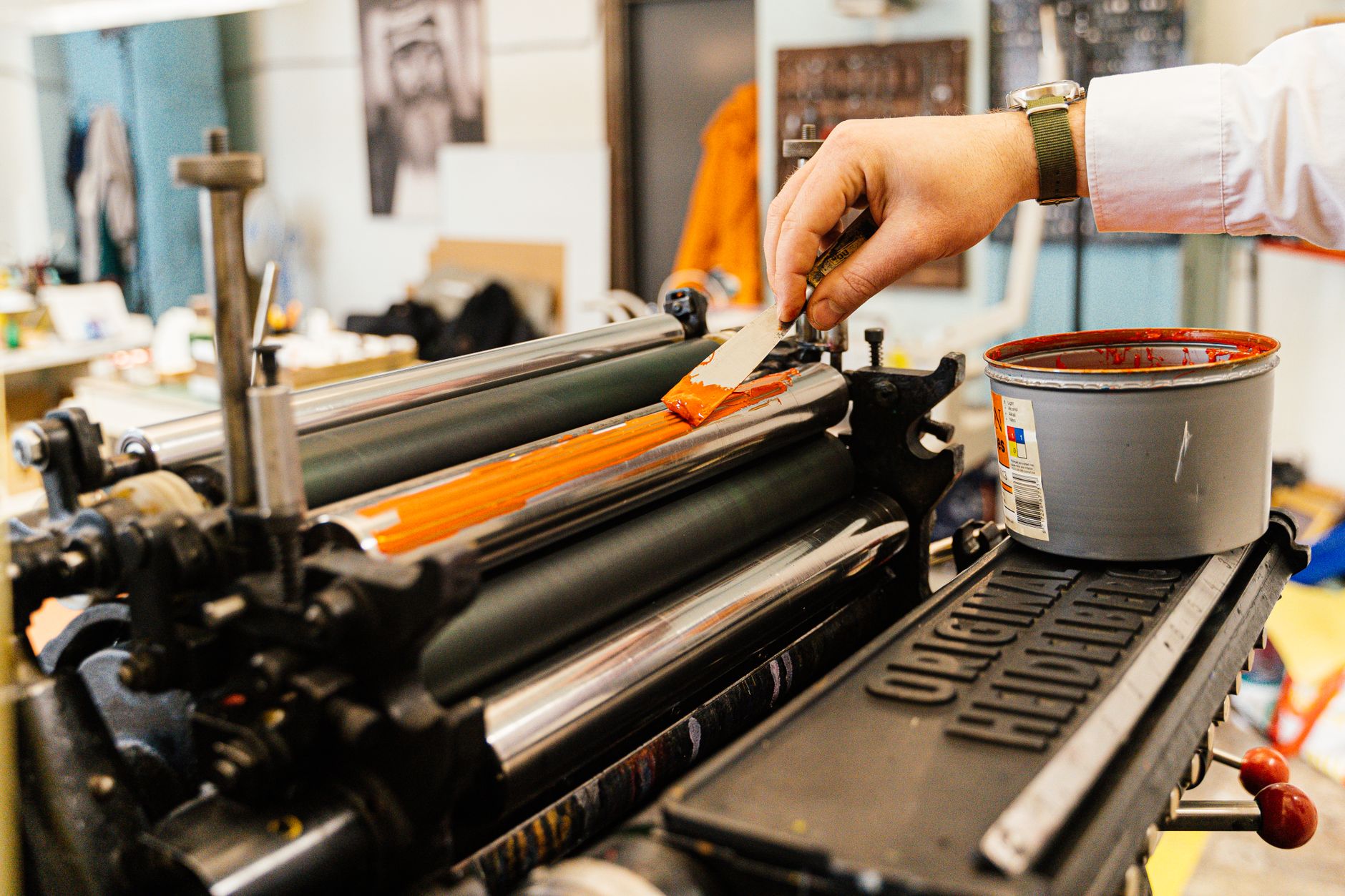
Every identity we ship is signed off on paper, in a print shop, by the person who drew it. It adds a day to the schedule and has saved more budgets than any tool we own.
The proof is the product
Clients rarely see a press proof. They see the finished box, the sign above the door, the menu on the table. But every one of those things was decided on a sheet of paper that came off a press a week earlier — and whoever signed that sheet decided what the client would live with for years.
That signature is the last moment anything can change for free. After it, a correction costs a reprint; after the launch, it costs a rebrand. So we treat the proof as the real deliverable and the files as the instructions for making it.
What a screen cannot show
A monitor is lit from behind. Paper is lit from in front, by whatever light happens to be in the room — a shop at noon, a kitchen at dusk, a train with fluorescent tubes. The same orange can look like a warning sign on one and a tired peach on the other.
That is why every identity we ship goes through at least two press proofs on the stock it will actually be printed on, checked by the designer who drew it, under three kinds of light.
A screen can show you a colour. Only paper tells you whether it will survive a shop window in August.
Marta Leal, on the Oda packaging
Four checks we never skip

The list is short on purpose. It fits on the back of a business card, and it goes to the print shop with whoever is on proof duty that week.
- Colour against the swatchThe approved Pantone chip goes on the sheet, under daylight, tungsten and a phone torch.
- Fine type at its smallest sizeLegal lines, ingredients, the 6 pt address. If it closes up, it goes up half a point.
- Registration on the tightest overlapA loupe on the one spot where two inks meet. A hair of white there reads as cheap from a metre away.
- The paper itselfHow it folds, how it smells, how it ages after a week on a sunny desk next to the window.
When the proof is wrong
It usually is, the first time. We mark it up in pencil, send it back the same day and go to the printer for the second one. A day lost at proof stage is cheaper than ten thousand boxes in the wrong red.
Across the last forty identities, the first proof was right four times. The second was right thirty-one times. The other five needed a third — and every one of those was a paper problem, not a colour one.